LIQUID CO₂ STORAGE & TRANSPORT
Liquid CO₂ Lorry Tanker
Bulk road delivery, coordinated with the loading station and the customer’s receiving tank.
Discuss your delivery requirements ↗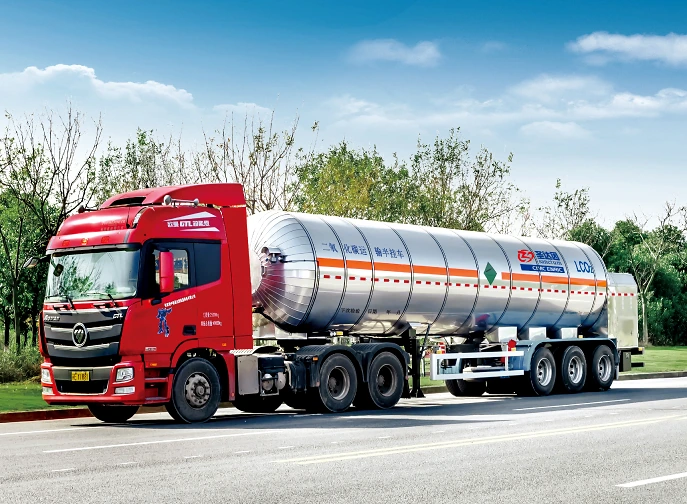
Match the vehicle to the delivery network
We include liquid CO₂ lorry tankers, also called road tankers, in our storage and distribution range. We coordinate the transport equipment with your plant’s loading station and the customer’s receiving facility. The choice starts with required deliveries, road access and permitted vehicle mass, rather than tank volume alone.
Our review covers the vessel, trailer or vehicle arrangement, transfer system and the responsibilities of the equipment supplier and operator. We confirm the CO₂ service and the approved configuration. Specifications for LNG, oxygen or nitrogen tankers cannot be transferred to a CO₂ tanker simply because the vehicles look similar.
Define payload and transfer conditions together
| Selection point | What we establish with you |
|---|---|
| Delivery plan | CO₂ required per trip, number of customers, delivery frequency, journey time and time spent loading or waiting. |
| Legal payload | Permitted gross mass and axle loads, tractor/trailer compatibility, tare mass and the approved filling quantity. |
| Site access | Vehicle dimensions, turning and parking space, loading-bay layout and receiving-site access restrictions. |
| Receiving tanks | Available receiving capacity, pressure and temperature conditions, connection standards and product requirements. |
| Transfer equipment | Required unloading rate, transfer method, pump scope where applicable, vapor connection and control interfaces. |
| Verification | Applicable vessel and vehicle approvals, inspection records, loading/unloading documents and handover responsibilities. |
Plan a complete delivery cycle
We review loading, travel, customer unloading and return time as one cycle. A larger tank does not necessarily deliver more saleable CO₂ if road-weight limits reduce the permitted load, or if the receiving site cannot accept the shipment. We compare practical delivered mass and vehicle utilization against your dispatch plan.
The loading system must also fit the recovery plant’s usable inventory and production schedule. We define whether loading equipment is stationary or vehicle-mounted, which party provides hoses and connections, and how the receiving tank’s available capacity is confirmed. Detailed operating procedures and safety settings remain in the approved equipment and site documentation.
Questions we resolve before quotation
- Can we quote from annual CO₂ output alone? We also need daily dispatch, delivered quantity per trip, route time and the receiving conditions. Annual production does not define the vehicle duty.
- Is unloading by pump always required? We evaluate the transfer method from vessel and receiving conditions, the required rate and the approved equipment design. We do not prescribe one arrangement for every site.
- How does a road tanker differ from a tank container? A tanker is planned around road delivery and its vehicle arrangement. A tank container is planned around container handling and its approved transport modes.
Send us your road-delivery requirements
Please provide the destination country, CO₂ quantity per trip, routes and distances, vehicle and axle limits, existing tractor details where relevant, loading-bay information and receiving-tank conditions. We can then define the supply scope and identify the documents needed before ordering.
Request a project-specific proposal ↗