PRODUCT CENTER / COMPLETE SYSTEMS
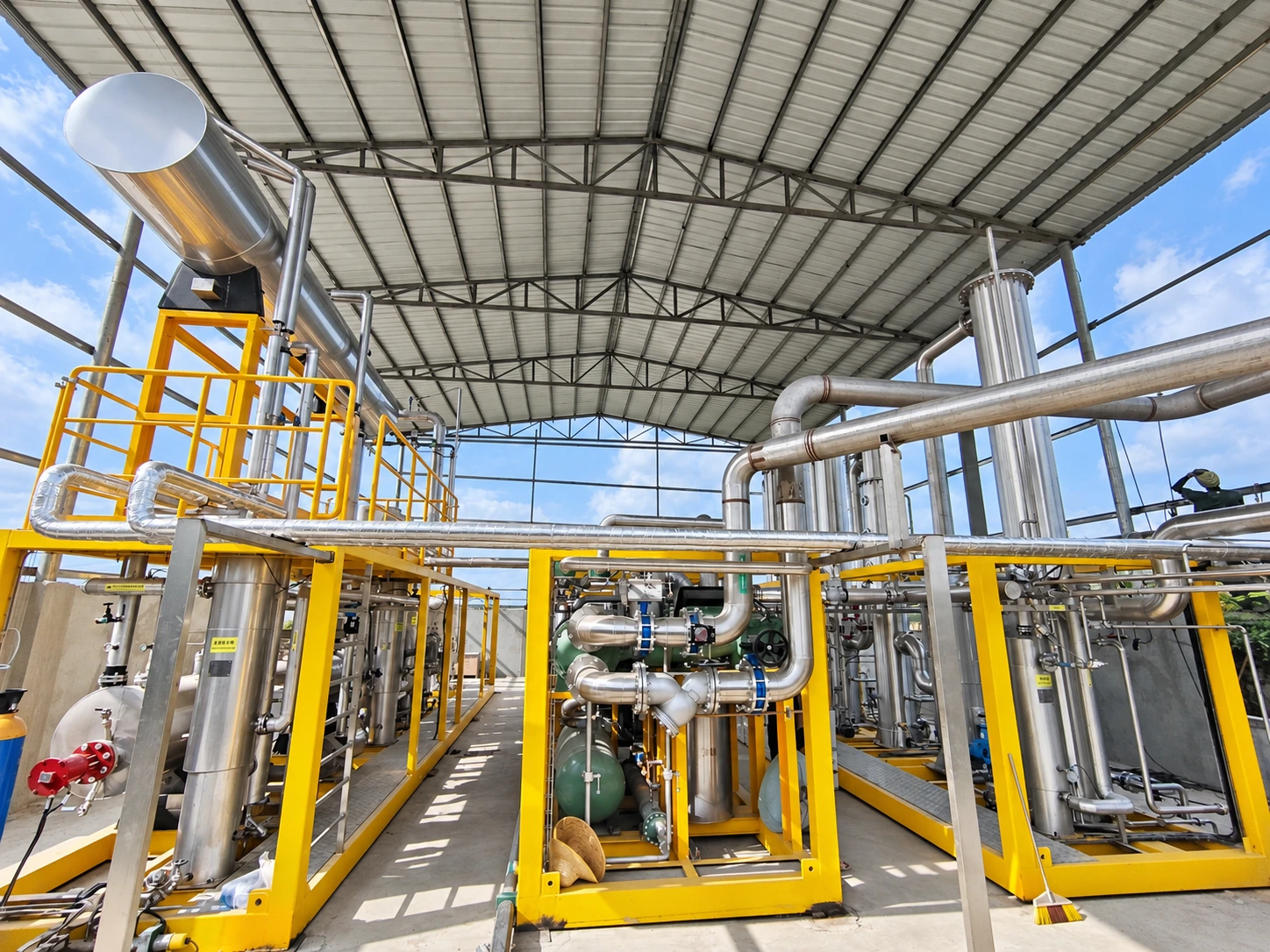
Food-grade CO₂ Recovery Plant
We integrate CO₂ recovery, purification and liquefaction into one plant for food and beverage applications. Each system is engineered around the accepted gas source, product specification and required output.
| Project element | Design basis |
|---|---|
| Feed | Accepted CO₂-rich gas; source and contaminants must be assessed |
| Portfolio range | Our portfolio range: 80–20,000 kg/h; suitability is confirmed for your source and product specification |
| Output | Liquid CO₂ or gas after vaporization, as defined in the project scope |
APPLICATION OVERVIEW
Recover a usable CO₂ product. Design quality into every stage.
01
Source qualification
Identify the production process, raw materials, expected contaminants and possible process changes. Establish representative sampling before selecting the purification route.
02
Quality definition
Agree the applicable market requirements, customer specification, analytical methods, detection limits and sampling points. A nominal CO₂ percentage is only one item.
03
Process integration
Balance collection, pretreatment, compression, drying, purification and liquefaction with storage and the point of use. Define treatment for unsuitable feed and off-spec product.
04
Operational assurance
Include commissioning tests, routine verification, instrument calibration, change management and a product-release procedure in the operating plan.
FROM SOURCE TO PRODUCT
Food-grade CO₂ recovery and purification process
The route below illustrates a CO₂-rich feed. Flue gas needs upstream capture; biogas-derived streams need upstream separation and source-specific conditioning.
Match the plant to the gas source.
A gas holder or collection system balances variable production. Source acceptance and controlled diversion protect the downstream process from unsuitable gas.
Prepare the gas for compression.
Pretreatment depends on source contaminants. Fermentation carryover, soluble impurities, sulfur species and solvent traces require different treatment and monitoring strategies.
Create the required process conditions.
Compression and intercooling support the selected purification and liquefaction route. Liquid separation and machine protection are engineered around actual inlet conditions.
Control more than CO₂ percentage.
Adsorption and other selected purification stages manage water and specified trace contaminants. Bed regeneration and switching must preserve product quality throughout the operating cycle.
Produce liquid CO₂ to the agreed specification.
Refrigeration condenses CO₂. Refining and vent management address light gases where required. Product testing determines acceptance; liquefaction alone does not establish food-grade status.
Protect quality to the point of use.
Liquid storage, loading or vaporization must preserve product quality and comply with applicable pressure-system requirements. Operating procedures and traceable quality records complete the system.
PROCESS EQUIPMENT
CO₂ washing & pretreatment
Washing and pretreatment address selected contaminants and entrainment before downstream processing.
Explore equipmentPROCESS EQUIPMENT
CO₂ compression systems
Compression establishes pressure for the selected purification and liquefaction route.
Explore equipmentPROCESS EQUIPMENT
CO₂ adsorption & drying
Drying controls water before cold processing and product delivery.
Explore equipmentSPECIFICATION & SCOPE
Food-grade CO₂ quality and design requirements
We develop the process around the gas analysis, flow profile and required product. State every critical impurity limit and the measurement method alongside the CO₂ concentration.
| Item | Project definition |
|---|---|
| Feed | Accepted CO₂-rich gas; source and contaminants must be assessed |
| Portfolio range | Our portfolio range: 80–20,000 kg/h; suitability is confirmed for your source and product specification |
| Output | Liquid CO₂ or gas after vaporization, as defined in the project scope |
| Quality | Customer- and market-specific impurity limits; no universal blanket guarantee |
| Scope | Engineering, equipment, installation/commissioning support and after-sales scope by contract |
Capacity, utility consumption and product guarantees are finalized in the project proposal at agreed inlet conditions.
RELEVANT YTC EXPERIENCE
Food-grade CO₂ recovery project references
Compare source, scale and specification with your own requirements.
FREQUENTLY ASKED QUESTIONS
What buyers ask.
What makes CO₂ food grade?
Suitability depends on qualified sources, applicable product requirements, trace impurities, analytical verification and controlled handling. A single purity percentage does not establish compliance.
Can any gas source become food-grade CO₂?
Feasibility depends on source contaminants, achievable treatment, risk assessment, economics and the applicable acceptance requirements. Some streams may be unsuitable.
What does YTC need for a proposal?
A representative gas analysis, flow and concentration profiles, project location, target product specification, operating hours, utilities and required delivery form.
For food and beverage applications, review source qualification and the selected sample reports.
TECHNICAL INSIGHT
Understand the design decisions.
A quality chain from source to customer
A food-grade CO₂ recovery plant has two connected objectives: deliver the required quantity and preserve the specified quality. The first begins with a mass balance; the second begins with a source assessment. A brewery, distillery and chemical facility can each offer a CO₂-rich stream, but they bring different contaminants, operating changes and documentation needs. The proposal should explain both objectives rather than treating purification as an accessory to the liquefier.
The quality chain extends beyond the final process vessel. Product can change during storage, loading, transport or vaporization, so sampling points and ownership of the product specification need to follow the actual delivery route. An on-site brewery using its own gas has a different release and logistics arrangement from a merchant producer loading road tankers.
Specify the impurities that matter
Start with a schedule that identifies each required analyte, limit, unit and test method. Oxygen, water and source-related organic or sulfur compounds do not have the same treatment mechanism. A bulk CO₂ percentage can remain high while a particular trace impurity fails the customer’s limit. The purpose of washing, adsorption, phase separation and polishing is therefore different at each stage.
The sampling system deserves the same care as the analyzer. Suitable sample conditioning, documented calibration and a detection limit below the acceptance threshold help make a result usable. Selected online instruments can provide early warning and process feedback; laboratory analysis can cover additional compounds. Neither should be described as measuring impurities that are outside its method or range.
Define acceptance before manufacturing
An effective acceptance plan states the feed envelope, liquid-product delivery point, stable operating conditions and test duration. It separates capacity, quality, utility consumption and availability because these are different measures. The agreed procedure should explain how interruptions, unsuitable feed and off-specification material affect the result.
For our discussion, provide your product specification alongside the gas analysis, production schedule and delivery arrangement. This enables the engineering team to connect source selection, treatment stages, instruments and storage around one purchasing requirement. It also makes competing proposals easier to compare on a consistent boundary.
Questions for the technical review
Why is a trace-impurity schedule more useful than a purity headline?
It identifies the contaminants that must be controlled and the analytical methods needed to demonstrate acceptance. A total purity value alone does not describe them.
Can a plant be designed for both beverage and industrial customers?
A common process may serve several destinations if their specifications, product segregation, testing and delivery requirements are defined. Suitability must be established for each destination.
START WITH YOUR SOURCE
Turn your CO₂ source into a defined project.
Send your gas analysis, flow profile, product target and project location. We will help connect the technical questions with a practical supply scope.
CONTINUE YOUR TECHNICAL REVIEW
Connect the specification with the evidence.
Relevant references
Review source, nominal capacity and the recorded supply scope.
Explore ↗ENGINEERING TOOLAssess your CO₂ source
Estimate recoverable quantity using visible assumptions.
Explore ↗BUYING GUIDEPrepare your specification
Define feed conditions, quality, utilities and acceptance before comparing proposals.
Explore ↗